If you’ve been following this newsletter for a while, you know I have a thing about focus.
I’ve written about my 80/20 rule obsession that drives everything I do as a GTM leader. It simply recognizes how 20% of your GTM plays typically drive 80% of your wins, and how spreading your go-to-market resources thin across every possible opportunity is one of the fastest ways to lose at them all.
So over the years, I built something to help.
The GTM prioritization challenge
Every B2B tech company I’ve worked with or advised kicks off with the same uncomfortable conversation at some point in the annual planning cycle: “We’re chasing too many opportunities and aren’t winning enough of them.”
The overload of opportunities makes sense, and it really is a positive. I’d be more worried if my company couldn’t think of enough reasons for customers to buy. But an experienced product team may surface a variety of legitimate use cases. Sales will have their own list. Marketing will have another. Someone in the exec team went to a conference and came back convinced the company needs to “go big” in some adjacent market. Your biggest competitor just launched a new solution, and your board expects you to compete head-to-head with them, so there’s another.
Suddenly, you’ve got a whiteboard full of opportunities, a finite amount of sales capacity, a marketing team whose budget and resources are already stretched thin, and a leadership team wondering why the pipeline isn’t converting. Sound familiar?
Reality check: not all use cases are created equal. You need a structured way to prioritize the critical few GTM plays that your coordinated sales, marketing, and product teams will target.
My methodology
No, I didn’t invent portfolio management-style approaches to prioritization or the beloved heat map. This has been management consulting 101 for years. But management consultants are crazy expensive, and in my experience, they charge a sweet premium for their time to learn your business. My goal was to build a repeatable process to facilitate and drive leadership focus and decision-making, leveraging expertise that already exists within the business, without the massive cost.
So drawing on my experiences across multiple roles at Forrester, Informatica, and more recently as a marketing leader at Vertex Software and Precisely, I developed and continuously refined a proprietary methodology I’m calling the Right to Win Framework. The goal is simple: help leadership teams focus outbound efforts on the use cases where they have the strongest combination of market opportunity and an operational ability to execute.
(Note: I’m intentionally focusing on outbound. Your inbound leads may hopefully span a much larger variety of opportunities, and so long as you’ve put in the work to ensure your sales development reps know how to properly qualify if those leads should be pursued – that’s great!)
My Right to Win process runs in four phases:
- Market, customer, and win/loss analysis. Before anyone gets in a room together, we do the homework. What use cases are actually showing up in won deals? What patterns emerge from lost deals, and why? Where is the competitive landscape creating openings vs. closing doors? This phase grounds the entire exercise in evidence rather than opinion, and the latest AI analytic tools can accelerate this ramp-up stage exponentially.
- Facilitated subject matter expert workshops. This is where the magic (and the healthy tension) happens. I bring together product, sales, marketing, and other customer-facing leaders to brainstorm, validate, and challenge the opportunity universe. A key output of this phase is separating use cases into two buckets: ones where the business can prove they’re already winning with quality and converting pipeline, versus net-new opportunities worth exploring. Both matter. Both get scored.
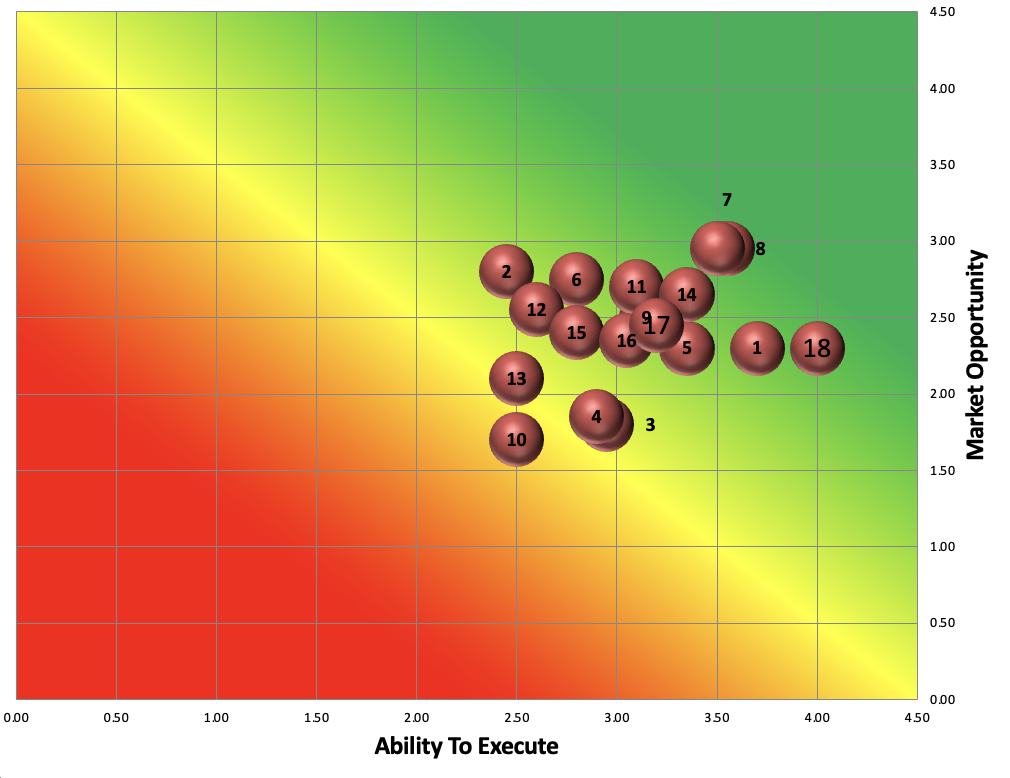
- Use case assessment model development and scoring. Each use case gets scored across two weighted dimensions: Market Opportunity (nine criteria, including buyer clarity, budget availability, and competitive landscape) and Ability to Execute (eight criteria, including field capacity and readiness, sales cycle length, and quality of customer references). The outputs are scores, ranks, and a 2×2 heat map that sorts use cases into quadrants.
- GTM play recommendations and execution planning. The model output isn’t the finish line; it’s the kickoff of the planning process. The final phase is translating scores and rankings into concrete GTM plays. Which use cases get campaign investment? Which ones need a lighthouse customer before they’re ready to scale? Which ones need a bit more R&D investment before taking action? Which ones get quietly shelved? The deliverable is a prioritized GTM plan, not just a pretty chart.
The spreadsheet that served me … well enough
For years, I ran this entire methodology out of a three-tab Excel workbook. A brainstorm tab for cataloguing use cases with customer themes, product coverage, descriptions, and proof points. A scoring model tab where each criterion was weighted and calculated with formulas (that would inevitably break when I least expected it). And a heat map tab that visualized everything on the 2×2.
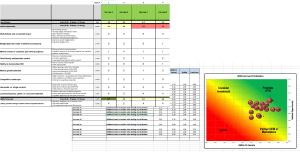
Right To Win Excel Model
It worked. It was flexible. It got the job done.
It was also, if I’m being honest, a pain to share, maintain, and hand off. Anyone who’s tried to collaboratively edit a complex Excel model with dropdown dependencies and cross-tab formula references knows what I mean. Every time I handed it to a colleague, I held my breath a little. I always thought it would be cool to have this built as a more user-friendly business app, but who had the time and money to work on something like that?
Not me. Until recently. But more on that in my follow-up article, “I Built My First AI App!“
The Right to Win is earned, not assumed
Whether you’re in annual planning mode or just trying to make sense of a whiteboard full of opportunities, the underlying question is always the same: Where do you actually have the right to win?
That requires honest analysis. It requires the courage to say no to the things that are exciting but not strategic. And it requires a framework that brings structure to what can otherwise be a very loud, politically-charged conversation.
The four-phase process above has served me well across multiple companies and market contexts. The specific weights and criteria may need tuning for your business, but the discipline of forcing every use case through a consistent, evidence-based evaluation is what makes the difference between a pipeline strategy and a pipeline wish list.
In Part 2, I share how I took this methodology, and the Excel model I’ve been running for years, and built my first AI-powered application using Claude Code. Without writing a single line of code.
In the meantime, want to see my Right to Win methodology in action for your business? I’d love to connect.