
One of the best parts of being a product marketing leader is the chance to build, structure, and grow a team of talented product marketers. But as I discussed in my article, “A B2B Product Marketer’s Worldview,” product marketing is a complex, cross-functional role with a challenging scope. You need to recruit for a variety of skills, backgrounds, and experiences to build a balanced team.
I’ve worked with many amazing product marketing managers (PMMs) throughout my career, and I’ve met top-notch PMMs from an extremely wide variety of backgrounds. From an education standpoint, great PMMs emerge from technical backgrounds like computer science or analytics, others from business-centric degrees in areas like marketing, communications, or economics, and still others start with a focus on research, creative thinking, and writing with majors across the humanities, journalism, and other liberal arts degrees. I was a Finance major myself, and had no idea what the heck a product marketer was when I graduated!
Four core product marketing skill sets
When looking to staff your product marketing team, I recommend focusing on four foundation skill sets and experiences. These include:
- Market research & analysis. This is the “External Insights” part of the product marketing role that I’ve discussed previously. PMMs perform ongoing competitive research, research pricing and packaging options, strive to understand customer and analyst perceptions, analyze win-loss-churn trends, and much more. PMM candidates that have deep experience in research, technology, and analytics excel in this part of the job.
- Messaging & positioning. As I shared in my article, “Messaging is everything, everywhere all at once,” PMMs are responsible for creating compelling and differentiated messages across a variety of positioning layers. Please note that I did not call this bullet ‘content creation and writing.’ Being an effective writer is important, but thankfully there are many talented people who can take a predefined theme and write an article, white paper, or ebook. When I’m recruiting PMM candidates, I’m looking for someone who can take raw insights and create a compelling story. If they can also then create content, that’s fantastic. But I’m also okay hiring expert writers and content creators – either as full time roles or contracted agencies, with my narrative-owning PMM team partnering with them to make it great. PMM candidates that have backgrounds in journalism and humanities-centric degrees can excel here.
- Cross-functional project management. As I shared in my article, “Ready to launch,” PMMs play a huge role in the complex, cross-functional coordination of major product launches that impact almost every function at a company. PMMs must be project managers that can scope a project, build a project plan, define roles & responsibilities, define communication plans, ensure ongoing coordination, monitor progress, measure impact, and report to executive leadership. That’s all while managing their other responsibilities. As businesses look to scale, the PMM team may eventually have the luxury of a full-time launch manager, or the company may set up a distinct Project (or Program) Management Office (PMO) that supports a variety of complex cross-functional initiatives, including product launches. Embedded launch managers or PMO partners are fantastic, as they allow PMM teams to dive deeper on the messaging and GTM strategies for the launch. Earlier stage companies do not have that luxury and must look to recruit PMMs that have proven project management skills.
- Go-to-market strategy. This is where it all comes together for a PMM. They’ve done their market research. They’ve worked closely with product management to influence and understand the product roadmap and vision. They’ve created unique and differentiated positioning and messaging. Now it’s time to help deliver the fuel for their company’s go-to-market engine. PMM partners with sales enablement teams to ensure the sales, pre-sales, support, and partner communities have the content and context they need to move leads through the sales and renewal cycles. PMM works closely with demand gen, content, website, PR/comms, social, community, and other marketing teams to ensure everyone knows the ‘who’, ‘what’, ‘when’, and ‘why’s’ to create the most effective campaigns, content, events, and media outreach to support the company’s brand perception and pipeline goals. Recruiting those with business degrees may offer some exposure to this type of strategic thinking. Did you notice I didn’t write “how or where” above? Keep reading.
- Note: PMMs define the GTM strategy, but they don’t own the execution. Execution is the ‘how’ and the ‘where’. PMMs do everything possible to ensure the success of their GTM partners, and provide as much insight as possible. But critical to fostering a positive relationship with your GTM peers is understanding that PMM does not determine the specific tactics used. Maybe you’d love to see an ABM campaign, publish a press release, or buy a prospect list. You can recommend it. But that’s not your job (or your budget). You’ve done your job well, now trust that your sales and marketing partners know how to do their jobs too.
Not every individual will start their product marketing career with all of these skills in their toolkit, but by building a balanced team with a focus on peer mentoring, coaching, and development, everyone can learn from one another.
In the graphic below, I’ve mapped some key product marketing deliverables to these skills.
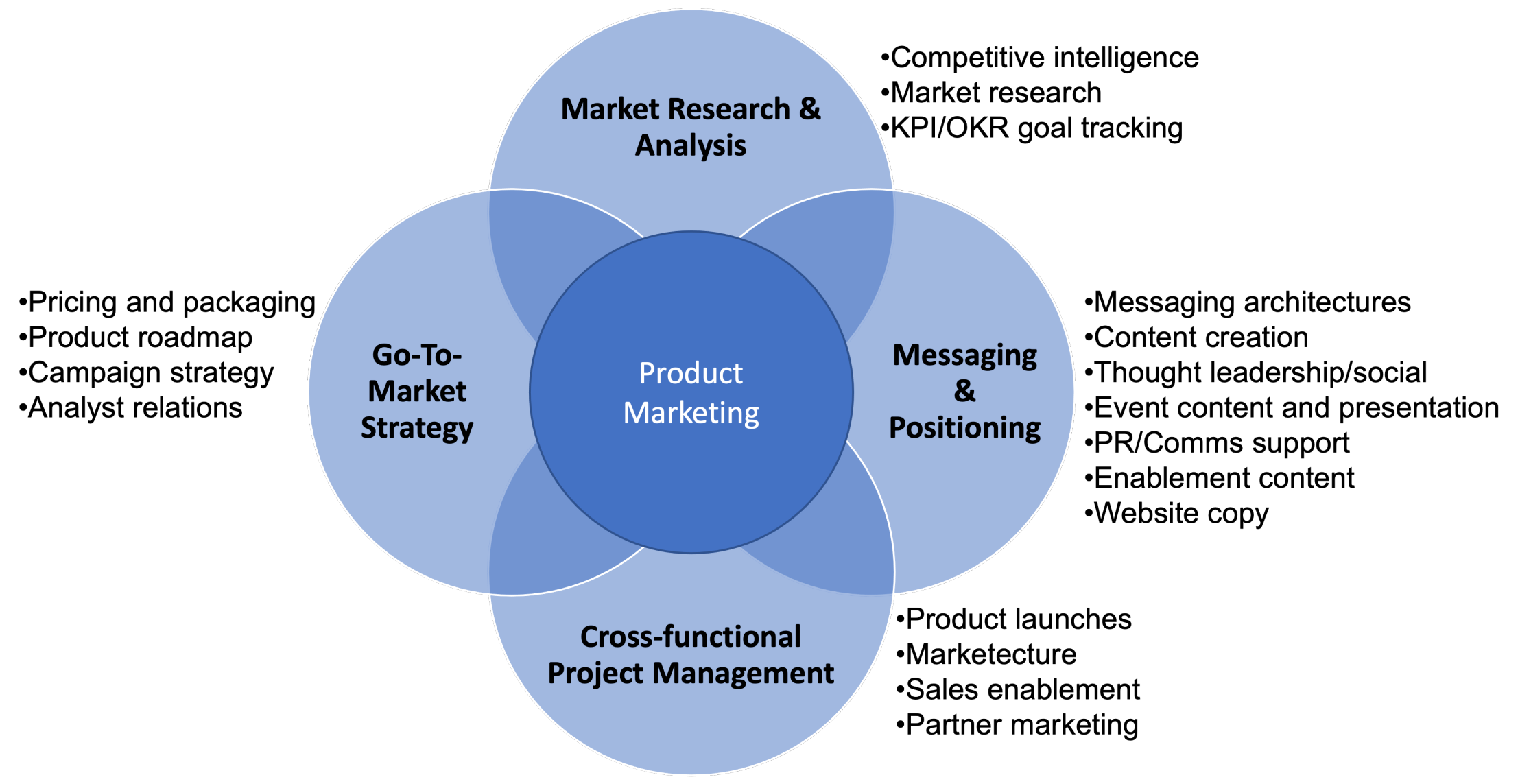
A product marketer’s core skill requirements
The evolution of a product marketing organization
The stage of your business should influence the size, makeup, and focus of your PMM team. Generalists that pretty much do everything will make up the team early on. But as you mature, specialization of roles can become a game-changer.
Every organization will start and evolve their PMM teams differently based on their market, product, and skills brought on board, but in my personal experience I’ve witnessed evolutions of PMM teams that look something like this graphic.

PMM teams will evolve to add specialized roles to support scale and complexity
Note in the graphic that I shared a ratio of how many product marketers an organization could have compared to the number of product managers (PMs). It’s common for earlier stage tech companies to invest its limited funding to build out their product organizations before ensuring its GTM teams can catch up. During this period you may only see one PMM for every 3 or 4 PMs (hopefully never 1:5!). But that ratio does not scale as your business grows. Individual PMs will not have the PMM support they need, and the PMMs themselves will burn out and have to sacrifice the quality and completeness of their work described above to focus only on reacting to incoming requests. Check out this great post on “The right ratio” by the Product Marketing Alliance (PMA), based on a survey they ran back in 2020.
In this article, I only focused on the skills that make up a great product marketing team. What I did not capture here is the importance of team chemistry. The most effective (and enjoyable) teams that I’ve been a part of always seemed to offer a fantastic balance of personalities, life experiences, and interests.