
Let’s start with the title of this article. I proudly borrowed from an amazing Oscar-winning best picture to get your attention. Not simply because it was topical and familiar – although that’s definitely intentional. But because it’s also a great representation of what I want to talk about in this article: the ubiquity and holistic impact of a business’s messaging.
The combination of the popularity of the movie, the relevance to this article, and the overall personal brand perception that I’m targeting for my newsletter (i.e., fun, intriguing, relevant, and not taking myself too seriously), led to this messaging decision! Did I make the right decision? I’ll track the article’s engagements and views and adjust next time if I missed the mark. Just like any product marketer should do when iterating and evolving their messages.
Messaging. Positioning. Building the narrative. Storytelling. Each term or phrase does have a nuanced distinction, but I hope founders, marketing leaders, brand marketers, and product marketers don’t get hung up on these terms. It’s more important that all are in agreement that these skills are critical to the success of any business – no matter its stage, size, or industry.
To oversimplify to the extreme, we’re just talking about the ability to develop the best words (no political humor here!), to be used by and for the right stakeholders, through the most appropriate channels, to generate a desired set of outcomes. (Yes, I re-read this and rolled my own eyes. Go ahead, I deserve it – but I stand by it as being pretty accurate!).
The layers of a messaging architecture
There are a ton of really useful messaging frameworks (aka messaging architectures or messaging maps) out there that will help break down many of the core messaging components needed (e.g., brand promise, value proposition, proof points, differentiators, etc). Whether it’s brand-, value-, product-, or another messaging-centric lens, I promise that a quick search will return a ton of examples that you can leverage.
But I haven’t seen a comprehensive representation of the meta-layers of messaging that product marketers must influence, so that’s what I’ve attempted to illustrate here. Each of these layers should have unique narrative requirements to most effectively support all go-to-market efforts.
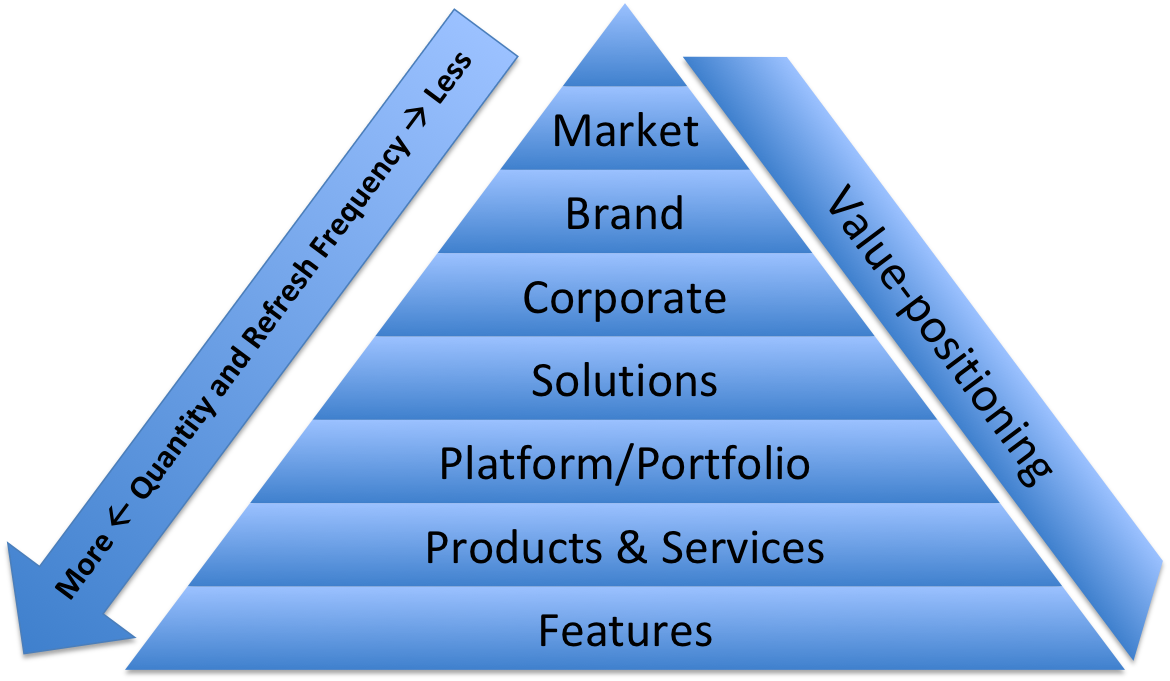
The layers of a messaging architecture
- Market. We’re not positioning your company or products here. We’re positioning the market you’re competing in to prove that it’s important (to your customers) and valuable (to your investors). Earlier-stage tech startups may first start talking about a market when they build a case to prove they’ve identified a product-market fit for their solution. The next important decision will be to determine if your company will be (a) competing in an existing, well-defined market category as defined by Gartner, Forrester, or some other trusted 3rd party tech influencers; or (b) creating a new unrecognized market category, that you feel is the next big thing. But if you take this 2nd path, you need competitors and analysts to embrace this market as well. Who’s going to prioritize a technology no one else is discussing?
- Brand. Your brand identity is more than just colors, a logo, and a tagline. Your brand is like an epic song – it’s the marriage of both music (the design) and lyrics (the message) that make it great. Brand has the not-so-simple role of capturing the essence of who you are, what you do, why you do it, how you do it differently, and why it all matters through design and messaging principles that should influence every part of your business. Your branding efforts should result in attributes that express both the experience customers should have when engaging with your brand (e.g., reliable, friendly, available, trusted) as well as the impressions they have when engaging with your brand (e.g., bold, concise, funny, smart). These attributes should influence both the look and feel of your brand, as well as the words used when creating messaging across this entire pyramid.
- Corporate. Your company-level positioning is where you start talking about your actual business. It will start with your Vision: your long-term North Star aspiration that will someday drive a positive impact in the world. Your corporate message also includes your Mission, which focuses on what you’re doing today and for whom to achieve that Vision. And it will include your strategy, which will explain how you intend to support your mission and will include your company’s values as foundational drivers.
- Solutions. Solution messaging leans heavily on value-centric messages. They lead with the unique challenges being addressed vs. the technology that solves them. This messaging often uses a segment-specific lens to speak to customers and prospects who care most about distinct use cases, industries, regions, and personas. Read my article on solutions marketing for a deeper dive discussion.
- Platform or portfolio. If you sell more than one product, you need to start discussing how the combination of all your products and services creates that 1+1=3 value proposition for customers. Your product roadmap, your partner & integration strategy, your M&A strategy, and how you define your broader technology ecosystem will also play a heavy role here. And yes, this is often the messaging layer that drives the need for a Marketecture – check out my article on that topic.
- Products and Services. Hopefully familiar ground for most product marketers – this is the foundational message map that captures the who, what, where, why, and how for each and every product and service offered. You can use this same type of map when building solution, platform, or even product-launch messaging. It’s critical to create this map – and maintain it ongoing – as a reference guide for all those creating copy, content, campaigns, presentations, and enablement. It ensures there is a consistent story being told through all channels using the most important and differentiated aspects of your offerings. I’ve shared an example below of a message map that I have often used. Feel free to leverage and tweak as needed to best support your needs.
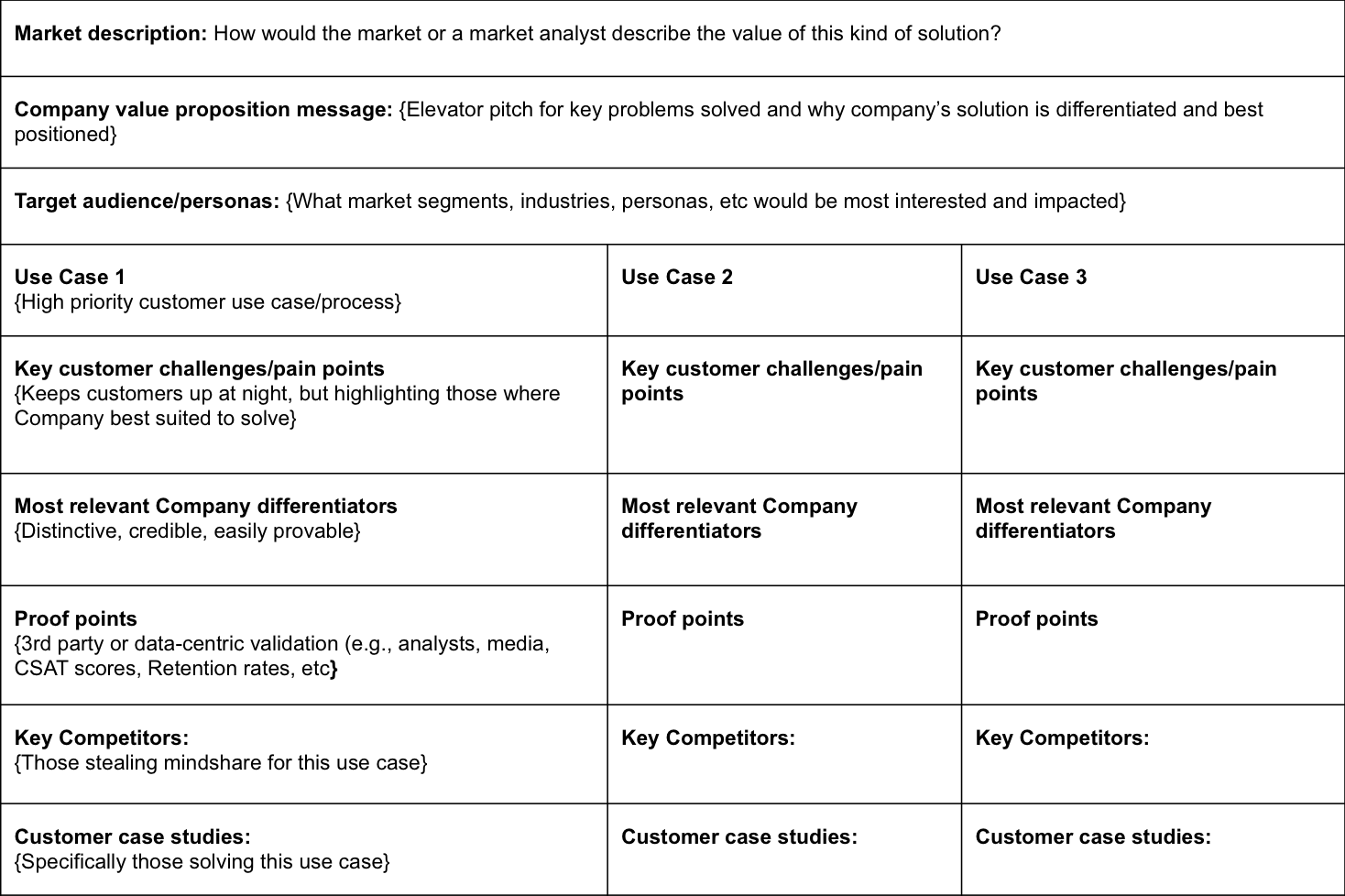
Message map for {Platform, Product, Solution, Service, Launch…}
- Features. You’ll quickly face diminishing returns if you try to create distinct messaging for every single feature your product offers. But you do want to give serious thought to how you position the product capabilities you feel are the most influential in attracting and retaining customers, beating competitors, influencing industry analysts, improving adoption, and helping you to differentiate. You’ll want to evaluate the opportunity to position new or updated features when you’re building your product launch strategy. The key questions you want to answer for these most relevant features include “What it does”, “Why it matters to your customers”, and “Why it’s first/better/best relative to alternatives.”
You’ll notice in my graphic that I placed a “Value-positioning” overlay that crosses every other messaging layer. This is intentional because there is no level in this hierarchy that does not benefit by spelling out the value being delivered.
Also, be aware that the one bullet per layer that I allowed myself above is in no way an attempt to capture all of the detailed deliverables that must be created for each. And stay tuned – I’m thinking of a future article all about TOFU, MOFU, and BOFU!