
One of the best parts of being a product marketer is that you get to play a big role in naming stuff! What category do we compete in? How do we brand our platform in our Marketecture? What do we call our sales plays when enabling our sales teams? Not surprisingly, one of the most important naming decisions product marketers and product managers collaborate on will be what names you assign to your products, product families, and important features.
For any parents out there, you know baby naming starts out fun but quickly turns into a 9-month exploration of life, the universe, and everything. “We can’t name our son that. I grew up with a kid with that name, and he ate glue and other unmentionables.” “We can’t use that other name, that’s what my sister named her dog”. “We can’t use a hard-to-spell name, our last name is tough enough to spell as is!” “We can’t name him Jack Ryan Karel, everyone will think we’re obsessed with Tom Clancy, not to mention his initials would be JeRK!” (That was a real conversation!)
But these conversations you have with your partner when naming your children aren’t much different than the conversations you have with your product management partners when trying to name a new product or feature. “We can’t use that product name, our competitor already uses that.” “We can’t use that name, nobody will understand what we’re talking about.” “We can’t use that name, it’s mind-numbingly boring!” “I love that name, but it looks like someone else owns the trademark.”
However you come to your final decision – just like with your kids, product names are long-term decisions that you will likely need to live with for many years. (Or at least until your kid turns 18 and decides to change their name to something that makes you roll your eyes….). I have a few suggestions on how to approach naming products and features in a structured and disciplined way, which can hopefully maximize your go-to-market positioning and minimize internal debates.
What’s in a name?
There are plenty of product naming taxonomies and approaches out there, and if you’re truly starting from scratch, you should really consider researching these, so you have a framework to get going. First and foremost, this is truly a corporate brand level conversation that must take place at the highest levels of your organization to determine which is most important to you, your corporate level brand (e.g., your company name) or your product level brands.
As an example, many years ago I worked for Intuit. At that time, everyone knew its products, QuickBooks, TurboTax, and Quicken, but very few of their customers were that familiar with the name Intuit. The product brands were so strong, and the company did such a great job building brand loyalty and awareness at the product brand level that the company brand was an afterthought. But as Intuit scaled, it became important to promote and build awareness of the corporate brand to better support its efforts to cross-sell and expand into adjacent markets. So they invested in a large, multiyear effort to promote the corporate brand of Intuit, and renamed all their products to make Intuit the primary brand and the product names as a sub-brand (e.g., Intuit QuickBooks, Intuit TurboTax). Intuit did a terrific job here, and I expect most would agree that today, both their corporate and product brands are equally strong and understood in the market.
But for this article, I’m going to simplify things a bit. At the highest level of product naming, I consider two primary approaches: descriptive or branded.
I’ll quickly define these two approaches (as well as a hybrid of the two) and then discuss the pros and cons of each:
- Descriptive: The name is going to describe what the product does based on the technology category you compete in, and you simply put your company name in front of it. The last 3 companies I worked for chose to use descriptive product naming most of the time for their major products (with a bit more leeway for differentiated features). So, for example, Lattice has Lattice Performance Management, Okta has Okta Single Sign-On, and Informatica has Informatica Cloud Data Integration. Are these names sexy and exciting? No. Are they 100% clear about what problems they are solving and when customers should consider evaluating them? Absolutely. It is extremely common for B2B businesses to rely on descriptive naming, often, but not always.
- Branded: The name is meant to evoke more of an emotion or awareness from customers that this product can deliver something unique and valuable for them. You often see branded product names in B2C. Car models are called Mustangs, Highlanders, and Broncos. CPG conglomerates like P&G and Clorox each have dozens of sub-brands for every product line.
- Hybrid: For large, global B2B technology companies like IBM and SAP, for instance, their portfolios are so huge with many products coming through acquisitions that you’ll see a mix of both descriptive and branded products throughout. Very often you’ll see the former acquired company name become the branded name of the product line (e.g., Cognos or SPSS for IBM, Ariba for SAP). On the B2C side, Apple also has an interesting approach, sometimes using both descriptive (e.g., iPhone, iPad, Apple Watch, Apple TV+) and branded (AirPods, Macbook, AirTags) products.
In the table below, I’ve summarized what I believe to be the pros and cons of these approaches.
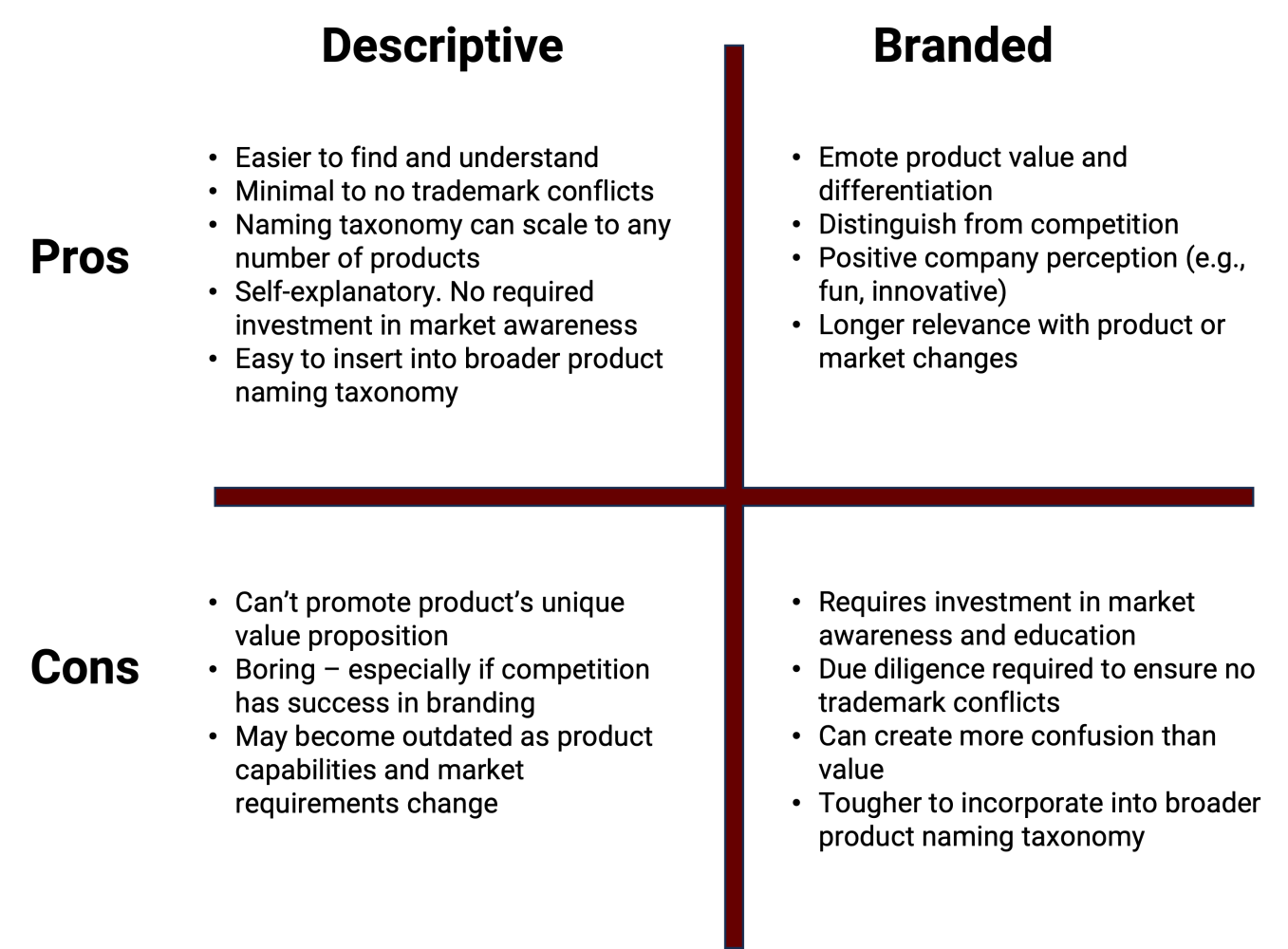
Pros and cons of descriptive vs branded product-naming approaches
A note on naming features
Hopefully we’re all in agreement that most of your features should be very plain language and descriptive. This is especially true for the vast majority of features that are likely commoditized and expected to have minimum viable capabilities to even compete in whatever market you’re in. For example, consider single sign-on integrations for B2B apps. Nowadays, you must offer this to compete, and very few are able to offer anything particularly differentiated here. So just call the feature SSO integration, don’t brand it the “SSOoo Great Integrator!”
But you should, in fact, have a handful (or hopefully more) features that truly set you apart as key differentiators. If you’re really innovative, you may even have a patent or two on these features that not only give you first to market but may also inhibit the competition from catching up any time soon. In these cases, you can consider the pros and cons (similar to the evaluation above) of creating a branded name vs descriptive one for these trailblazing features.
An example of this that comes to mind was from Salesforce. Most of their products have descriptive names (with the exception of some acquired products like Slack, Tableau, and MuleSoft). But back in 2019, when Salesforce launched their new platform design capabilities with a new user experience, they called it the Lightning Experience. Salesforce continues to promote this branded platform feature as a way of describing their differentiated UX, and they clearly had the resources to invest to ensure the market understood what it was and has customers speaking this language today.